A Rancher Kept Finding Teeth on His Land. It Was a $50 Million T. Rex.
How a Tyrannosaurus named after a South Dakota cattle rancher became the most expensive fossil ever sold, and left public science on the same morning.
The Ranch Above the Hell Creek
For years, Gary Licking kept finding pieces of something on his cattle ranch in Harding County, South Dakota, eleven miles west of the town of Buffalo. Teeth, mostly. Fragments of bone working their way out of the badlands the way they have been doing there for sixty-seven million years. He was a rancher, not a paleontologist, and for a long time the finds were a curiosity on land he worked for a living.
Eventually he called someone. In 2021, Theropoda Expeditions, a commercial outfit out of Texas, came to dig. What was under the Hell Creek Formation was not a curiosity. It was one of the largest and most complete Tyrannosaurus rex skeletons ever recovered.
Licking did not live to see it sold. The animal carries his nickname. Everyone called him Gus.
Three Years Digging, Two Years Rebuilding
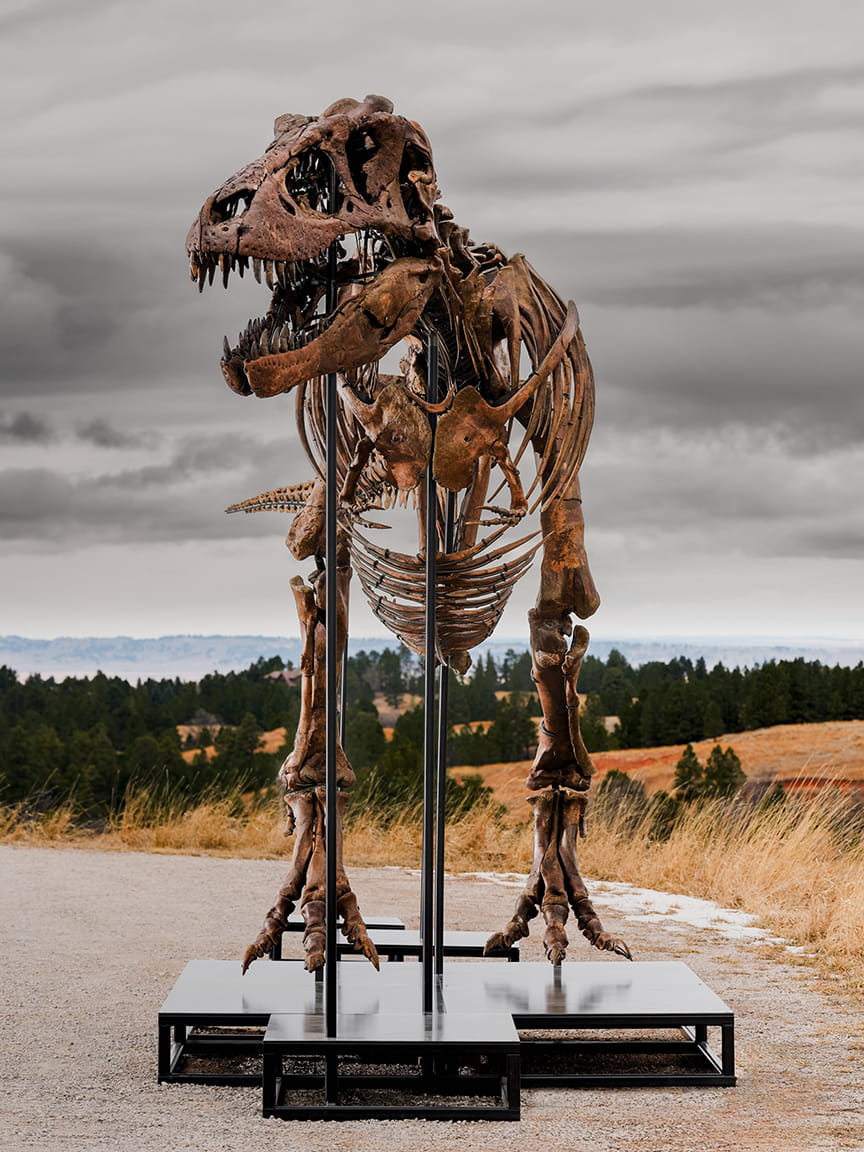
Excavation took three years. Preparation and mounting took two more. What came out was 183 skeletal elements: sixty-one percent of the bones a T. rex is thought to have, and because the survivors are the big ones, closer to seventy-five or eighty percent of the animal’s original bone mass. The skull alone is eighty-two percent complete, and the skull is the part that almost never survives.
Mounted, Gus stands twelve and a half feet tall and runs thirty-eight feet nose to tail. The skull is fifty-four inches long. The femur measures 50.39 inches. Thirty of the thirty-two gastralia — the belly ribs that float unattached in the abdominal wall and are almost always lost — came up with the rest of it.
The bones also carry a record of a bad day. There is damage consistent with a bite from another T. rex, the kind of detail that says something about how the animal lived rather than simply what it looked like.
“Gus is not only an exceptional find, but a specimen that’s been excavated, documented, prepared, and cared for with real excellence,” said Cassandra Hatton, Sotheby’s global head of science and popular culture.
Ten Minutes, Seven Bidders
On the morning of Tuesday 14 July 2026, Sotheby’s New York opened the lot at $19 million against a $30 million estimate. Seven bidders, in the room and on the phones and online, spent about ten minutes taking it apart. It closed at $50,130,000.
That is the most anyone has ever paid at auction for a fossil. It beat Apex, the Stegosaurus sold in the same room in July 2024 for $44.6 million, by five and a half million dollars. Stan, the T. rex that went to Christie’s in 2020 for $31.8 million and held the previous mark for the species, is now third on our own index.
The buyer has not been named.
The Part the Price Does Not Cover
Within days the Society of Vertebrate Paleontology condemned the sale, restating a position it has held for decades: that scientifically significant vertebrate fossils belong in the public trust, held permanently in museums and universities where researchers can go back to them.
The objection is not sentimental. “Science depends on independent verification of claims and healthy debate,” wrote Kristi Curry Rogers, professor of biology and geology at Macalester College and the society’s president-elect. “Researchers must be able to revisit specimens, test earlier conclusions and ask new questions.” A specimen in a private collection cannot promise that. Loans get revoked. Access becomes a favour rather than a right.
The practical consequence is that no scientific work on Gus has been published, and under current norms none is likely to be. Reputable journals will not accept a study built on a specimen that future researchers may be unable to examine. A 2025 count put sixty-one T. rex specimens in public trust against seventy-one in private hands, which means more than half of every T. rex ever found now sits outside the reach of the people whose job it is to study them.
Gus spent sixty-seven million years in the ground, three years coming out of it, and two more being put back together. It took ten minutes to disappear.