
Salvator Mundi Sold for $450M. Nobody Will Say Where It Is.
How Salvator Mundi became the most famous painting almost nobody can see
Before Salvator Mundi became a $450 million object of obsession, before it was marketed as the last Leonardo, before it vanished into the private weather system of billionaires, museums, governments, and rumor, it had already performed its first trick. It had disappeared without going anywhere.
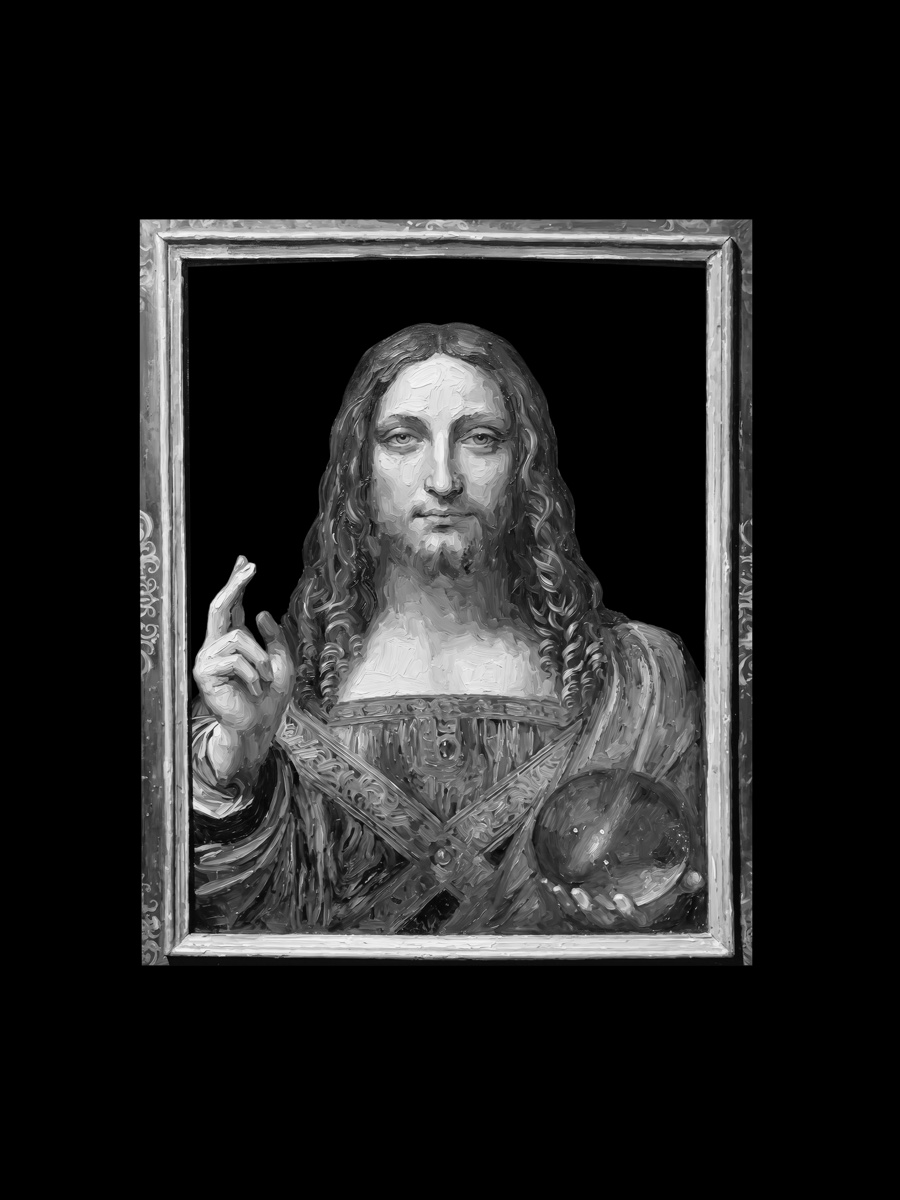
For centuries, the painting existed as a kind of art-historical error message. Christ faces forward, one hand raised in blessing, the other holding a transparent orb. The title means “Savior of the World.” If the attribution is correct, Leonardo da Vinci painted it around 1500, during the same period when he was pushing European painting toward something stranger, softer, and more psychologically charged than anything that had come before.
But that phrase — if the attribution is correct — is the trapdoor beneath the entire story. Salvator Mundi is not just a painting. It is a problem disguised as a painting. A corrupted file. A missing object. A sacred image turned into a luxury asset. A masterpiece that may or may not be a masterpiece, depending on whom you ask, what layer of paint you trust, and how much restoration you are willing to believe in.
The First Disappearance
For a while, the painting seems to have belonged to the kind of world that preserves things. It appears in royal collections. It is recorded, copied, moved, inherited, and sold. There are documents. There are references. There is a trail.
Then the trail starts to break.
Ownership becomes uncertain. Mentions grow thinner. Records blur. The painting drifts from fact into rumor, from rumor into absence. Eventually, it disappears from the public record for more than a century. In art history, that is not just a gap. It is a kind of death. Provenance is memory, and when memory fails, even a physical object can become lost.
The image survived in copies and documents, but the painting itself slipped out of view. Nobody needed to destroy it. Nobody needed to steal it. Time did the work quietly. The first ghost story of Salvator Mundi is not that it vanished in a dramatic act of theft or war. It is that it was slowly misremembered until it became almost impossible to find.
A Masterpiece With a Metadata Problem
When the painting eventually resurfaced, it did not look like a revelation. It looked like damaged goods.
The panel had been altered. The surface had suffered. Important details were buried under layers of overpaint. Earlier restorations had changed the way the picture looked. The face, the hair, the blessing hand, the orb — all the things that might have carried the signal of Leonardo’s hand — were obscured by centuries of intervention and neglect.
So the art world did what systems do when the data is messy: it downgraded the file.
The painting entered collections not as a Leonardo, but as a work by a follower, a studio assistant, or someone painting “after Leonardo.” That phrase sounds technical, but in the art market it is brutal. “After Leonardo” means derivative. It means copy. It means the aura belongs somewhere else.
This is the strange genius of the painting’s disappearance. It did not vanish because nobody could see it. It vanished because nobody could identify it. People could stand directly in front of Salvator Mundi and still miss the possibility of what it was. The object remained. The identity was gone.
The Copy That Might Not Be a Copy
For decades, Salvator Mundi drifted through the world under the wrong name. It was bought, sold, catalogued, and forgotten. Damaged. Misattributed. Unremarkable. Then, in the early 2000s, it surfaced again at a small estate auction in New Orleans, still carrying the label that had kept it invisible: “after Leonardo.”
At that moment, it was not yet the most expensive painting in history. It was not yet a diplomatic mystery. It was not yet a symbol of extreme wealth, expert disagreement, and institutional anxiety. It was just an old religious painting with a damaged surface and a famous name hovering faintly in the background.
But the great drama of Salvator Mundi is that labels can fail. A painting can be misfiled for generations. A masterpiece, or something close to one, can sit inside the wrong category until someone decides to look again.
That is when the ghost began to sharpen.
Restoration as Resurrection
After the painting was acquired, restoration began to peel back the centuries. Layers of overpaint were removed. Forms that had been flattened or obscured began to reappear. The curls became more legible. The blessing hand regained its delicacy. The face emerged from beneath the murk. The crystal orb, strange and almost science-fictional in its stillness, returned to view.
Restoration did not simply clean the painting. It changed the argument around it.
Before restoration, Salvator Mundi could be dismissed. After restoration, it demanded an answer. What if this was not a copy? What if the thing everyone had overlooked was, in fact, the missing Leonardo? What if the world had spent generations walking past one of the most important paintings ever made?
That possibility was explosive because it touched everything at once: scholarship, money, ego, faith, technology, and desire. Some experts saw Leonardo in the softness of the face, the modeling of the hand, the strange psychological quiet of the figure. Others saw a painting too damaged, too reconstructed, too compromised to support the claim. To them, the restoration had not revealed a Leonardo so much as created an image the market desperately wanted to believe in.
And belief, in the case of Salvator Mundi, became part of the medium.
The Painting Becomes a Platform
By the time Salvator Mundi reached the global auction stage, it had become something larger than an artwork. It was now a story engineered for the modern attention economy: lost masterpiece, forensic recovery, expert conflict, royal provenance, religious iconography, astronomical price, and just enough doubt to keep everybody arguing.
The painting was no longer merely being sold. It was being launched.
Its uncertainty became a feature, not a bug. A fully settled painting is valuable. A possibly lost Leonardo is radioactive. The dispute gave it velocity. Every skeptic made the story bigger. Every defender raised the stakes. Every headline turned the painting into something more mythic and less stable.
In 2017, when Salvator Mundi sold for $450.3 million, the number seemed to overwhelm the object itself. The painting crossed out of art history and entered another realm entirely — one populated by sovereign wealth, private museums, soft power, and trophy ownership. It became less like a canvas than a signal flare from the highest altitude of global money.
The Second Vanishing
Then, after becoming one of the most famous paintings on Earth, Salvator Mundi disappeared again.
This time, it was not lost because records failed. It was not swallowed by centuries of neglect. It vanished under conditions of maximum visibility. The whole world knew the painting. The whole world knew the price. The whole world knew the controversy. But almost nobody could actually see the object.
Expected exhibitions did not unfold as planned. Public appearances became uncertain. Rumors replaced sightings. The painting’s absence became its own kind of performance. Every nonappearance made it more famous. Every unanswered question added another layer to the myth.
The first time Salvator Mundi disappeared, it was because no one recognized it. The second time, it disappeared because everyone did.
The Most Visible Invisible Painting in the World
That is what makes Salvator Mundi feel so modern. It is a Renaissance painting trapped inside a twenty-first-century machine. Its story is about authentication, branding, secrecy, wealth, access, and the instability of truth when too many powerful people have a stake in the answer.
The painting’s subject is Christ holding the world in a crystal orb. But its real subject may be visibility itself. What does it mean to know an image but not be able to see the object? What does it mean for a painting to be famous mostly as a file, a headline, a rumor, a price tag? What happens when an artwork becomes so valuable that public access starts to feel almost beside the point?
In that sense, Salvator Mundi is not a ghost because it is gone. It is a ghost because it keeps changing form. There is the lost painting in the records. The damaged painting at auction. The restored painting in the conservation studio. The disputed Leonardo in the scholarly debate. The $450 million trophy. The missing object. The myth.
Each version is real. None is complete.
The Kicker
Five centuries after it may have left Leonardo’s studio, Salvator Mundi remains suspended between masterpiece and mirage, relic and asset, sacred image and billionaire object. It was lost once by time, recovered by restoration, amplified by commerce, and hidden again by fame.
The painting did not simply disappear.
It learned how to haunt.